
Comprehensive Guide to Solar Thermal Energy and Concentrated Solar Power
Introduction to Solar Thermal Energy
Solar thermal energy harnesses the sun's abundant and renewable energy by concentrating sunlight to generate heat, which is then converted into electricity. This technology offers higher efficiency compared to traditional photovoltaic solar cells by increasing the surface area for solar absorption.
Basics and Working Principle
- Concentration: Mirrors or reflective glasses focus sunlight onto a smaller receiver area.
- Absorption: The receiver absorbs solar radiation and converts it into heat.
- Heat Transfer: Heat transfer fluids (HTF), often enhanced with nanomaterials (nanofluids), carry the heat to storage or power generation units.
- Storage: Thermal energy storage systems store excess heat for later use.
- Electricity Generation: Heat engines or turbines convert thermal energy into electricity.
This two-step process (sunlight to heat, heat to electricity) contrasts with photovoltaic cells that convert sunlight directly into electricity.
Historical Milestones
- 1866: August Mouchout's parabolic trough steam engine.
- 1968: First concentrated solar plant in Sant'Ilario, Italy.
- 2014: Ivanpah, California, world's largest solar thermal plant with 392 MW capacity.
Classification of Solar Collectors
Low-Temperature Collectors (<100°C)
- Flat Plate Collectors: Black flat surfaces absorb sunlight to heat water or air, used in domestic water and space heating.
- Solar Chimney: Uses heated air under a transparent roof to create airflow that drives turbines.
- Solar Pond: Large salty water bodies store solar heat in stratified layers for energy extraction.
Medium-Temperature Collectors (<400°C)
- Parabolic Trough Collectors (PTC): Cylindrical parabolic mirrors focus sunlight on receiver tubes containing heat transfer fluids.
- Fresnel Collectors: Arrays of flat mirrors focus sunlight onto a fixed absorber, concentrating solar energy about 30 times.
High-Temperature Collectors (>400°C)
- Central Tower Collectors: Multiple heliostats focus sunlight onto a central receiver atop a tower, achieving high temperatures and efficient heat storage in molten salts.
- Parabolic Dish Collectors: Satellite dish-shaped mirrors focus sunlight onto a receiver linked to Stirling engines, reaching temperatures above 1000°C.
Role of Nanomaterials
Nanomaterials improve thermal properties of heat transfer fluids and enhance absorber and anti-reflective coatings by:
- Increasing absorptivity and thermal conductivity.
- Providing corrosion and wear resistance.
- Enhancing durability and high-temperature tolerance.
Examples include nano pyramid tungsten, nickel, copper oxide nanowires, and silicon dioxide-titanium dioxide composites.
Coating Techniques for Solar Absorbers
- Chemical spraying
- Electrodeposition
- Vapor deposition
- Oxidation methods
- Dip-coating (sol-gel)
These methods improve heat absorption and reduce reflection losses.
Advantages of Solar Thermal Energy
- No fuel costs; uses renewable solar energy.
- Environmentally friendly with no pollution or greenhouse gas emissions.
- Utilizes existing equipment like mirrors and turbines.
- Thermal energy storage reduces reliance on batteries.
- Requires less space than photovoltaic systems for equivalent output.
- Lower running costs compared to coal or gas plants.
Disadvantages
- High initial capital investment.
- Significant water usage, problematic in arid regions.
- Large mirror arrays may impact wildlife.
- Limited to regions with high solar radiation.
- Not suitable for residential areas.
- Longer construction times compared to other energy sources.
Applications
- Electricity generation
- Solar desalination
- Solar cooking
- Water heating
- Sterilization
- Room heating and cooling
Summary
Solar thermal technology efficiently converts sunlight into heat and then electricity, outperforming photovoltaic cells in certain contexts. Various collector types cater to different temperature ranges and applications. Nanomaterials and advanced coatings play a crucial role in enhancing system efficiency and durability, making solar thermal energy a promising renewable energy solution.
For a deeper understanding of solar energy technologies, check out our Understanding Solar Energy: An In-Depth Explore of Its Types and Impacts and learn about the Comprehensive Guide to Concentrating Solar Thermal Power Technology. If you're interested in practical applications, see our guide on Designing a Solar Power Generation System for Homes Using MATLAB Simulink. Additionally, explore the Understanding Earth's Energy Balance and Solar Radiation for insights into the fundamental principles that govern solar energy.
Hello my friends, in this particular lecture, we are going to discuss about the Solar Thermal Energy. In our last lecture, we have discussed about the perovskite materials basically what we
are using nowadays for making the solar cell. So, in this particular lecture, the solar thermal energy is another the new or maybe the advanced techniques basically, so now people are working on it also.
So that we can get the maximum efficiency just to overread that in a solar thermal or maybe in solar panel maybe it is possible that sometimes we are not concentrating the whole sunlight over there.
So, just to resolve that particular problem, now people attending into these particular techniques. So, what is the basics of this particular techniques?
Basically, sun is the most abundant, reliable and renewable source of energy. As we know we are discussing this particular sentence in last couple of slides. So, basically, the solar thermal power, concentrated solar power basically, because why I am talking
this one is the concentrated; because I will come into the subsequent slides. Basically, in this particular case we are using some kind of mirror or maybe the reflecting glasses so that the whole energy solar energy basically we are concentrating in a particular
point and then we are focusing that particular solar energy into the systems. So, here the consumption of the solar energy is more. So, basically is relatively the new technology which is giving more efficiency than photovoltaic
solar cells, because in this particular case basically we are increasing the surface area of the observance of the solar light. So, automatically we are getting the more energy from the sun.
But basically, in the photovoltaic, you can see that there is one specific surface area, only up to certain level the sunlight is falling and then we are getting the efficiency or maybe the energy from the particular area small area of the sunlight.
But in this particular case we are consuming the sunlight in a very larger area. So, basically the solar thermal power electricity generation means, power of course, it is the electricity generation systems collect and concentrate sunlight to produce the high temperature
and heat needed to generate the electricity. So, in this particular case what happened? First, we are consuming the sunlight and then we are converting that energy into heat energy
and then from heat energy we are converting it into the electric energy. So, basically it is a two-step process. So, solar thermal collectors can absorb nearly the entire solar spectrum.
So, as I told already, so here the surface area is bigger. Say suppose, if for any kind of solar cell systems I am having the collector in this manner.
So, you can see if it is the round shape only the upper part will get the sunlight, not the bottom part. But if I am having a mirror of this much area, so the whole in sunlight whatever it is coming
over here that can be transferred into the system itself. So, nanoparticles can improve the thermal properties in the heat transfer fluids of solar thermal power plants to improve the efficiency, yes.
Nowadays, we are using the nanomaterials as an filler or maybe as nanomaterials we are adding in into the liquid, maybe it is maybe the water or maybe some kind of mineral oil or maybe some other systems.
Basically, the scientist are telling this one as a nanofluid. So, it is only than nanomaterial enriched fluid. So, if we talk about the history in the year of 1866 that August Mouchout used a parabolic
trough to produce the steam for the first solar steam engine; then, we have come to 1968 where the first concentrated solar plant which entered into the operation in Sant'ilario, near Genoa, Italy.
Then, we move to 2014 where we can see that world’s largest solar thermal plant it is almost 392-megawatt capacity achieves the commercial operations in Ivanpah, California, USA.
So, basically what happened? If you remember I can tell you one example that in our childhood we used to do one experiment. Just we are having one piece of paper we are having one magnifying glass, then if we put
the magnifying glass onto the paper under the sunlight, So, what will happen? If we adjust the focal length in such a manner that the whole sunlight whatever are falling on to the magnetic lens if will directly concentrate and put a on a particular point into the paper
the paper will burn. But if we put normal magnifying glass without maintaining its focal area the paper will not burn.
That means what? In a particular point the whole sunlight means whole energy I am concentrating into one. So, automatically that is the accumulations of the energy.
The same principles basically we are applying over here. So, we are using absorbing material, some kind of collector materials which is observing and collecting the sunlight and then it is connected in a particular point and then it
is putting on to some maybe water heater or maybe some other collector to hit the water or maybe to generate the heat. And then through that heat, we are boiling the water, so that it can make the vapor,
and through that vapor we can run the turbine and then generator will be coupled with the turbine, so that it can generate the electricity. So, basically that is the concept of this particular solar thermal energy.
So, in this particular case, if we talk about the difference between the solar thermal energy and the photovoltaic technologies, you can see in the solar thermal energy case basically we convert the sunlight into heat and then into the electricity.
So, basically, I told you this is the two steps process. But in the photovoltaic technology, so basically, we are converting the sunlight directly into the electric.
Then, for solar thermal we use basically well-known thermal conversion systems, in photovoltaic we are using the protons to electricity, in the solar thermal technology the storage cost is very less, but in photovoltaic the storage cost is maximum.
And efficiency achieved from solar thermal energy is almost 20 to 45 percent, whereas we have achieved 19 to 24 percent for photovoltaic that is also for the single junction silicon. So, now, let us discuss about the working principle.
So, as I told already. So, the basic principle of solar thermal is to transfer the solar radiation into the heat via a thermodynamic system which is essentially a generator or maybe the engine.
There are 5 steps to a conventional CSP systems. So, what are those? First one is called the concentrations; Sunlight incident on a large concentrator is redirected
to a much smaller receiver. Then we are using the absorption materials or maybe sometimes you are calling is an absorber. So, sunlight incident on the receiver is converted to heat by an observer.
So, simple first it is collecting and then it is not allowing to heat to go outside. So, that is why it is basically acting as an absorber it is observing the energy and that energy is converting into heat energy.
Then next one is called the transfer. So, heat is carried out from the absorber by the heat transfer fluid. As I told already, so in this particular fluid basically we are adding the nanoparticle,
so that it can absorb or maybe it can transfer the maximum amount of heat from one place to another. So, if I put any kind of ceramic materials which can absorb the more heat.
So, basically it will be a helpful. So, people are working basically on to that because if we use the nanomaterials the metal is having the more surface energy than the volume.
So, automatically if I use the nanomaterials, the nanofluid can carry maximum heat from one place to another. Next one is call the storage.
The heat can be stored in a thermal energy storage systems for later use. Generations, the HTF delivers heat. HTF is nothing but the heat transfer fluid to a heat engine which generates the electricity.
So, here actually we are getting two advantages, one advantage is that some thermal energy which is not used we can use it for maybe heating some water or maybe some kind of plant or maybe we can do some kind of other process also.
So, that storage can be done. Simultaneously, with storage also we can utilize that heat for certain other purpose and the rest we are using directly to generation of the electricity or maybe it is a vice versa
one. So, while transferring the heat from one place to another maybe I am making another subchannel, so that I can store the heat energy, the excess one and maximum we are utilizing for generating
the electricity. So, basically what are the classifications of the solar collectors? First concentration solar technologies it has been divided into 3 parts, first is called
the low temperature which is nothing, but below 100 degree centigrade, medium temperature or maybe the line focusing which is below 400 degrees centigrade, another one is known as the high temperature or maybe the point focusing which is more than 400 degree centigrade.
If we talk about the low temperature then we are having 3 divisions, one is called the flat plate collectors, solar chimney and the solar pond. If we talk about the medium temperature then we are having two types, one is called the
parabolic trough collectors that is PTC, Fresnel collectors. If we talk about the high temperatures we are having two, one is called the central tower collectors another is called the parabolic dish collectors.
So, all these classifications I will discuss in my subsequent slide one by one. So, just let us start with the low-temperature collectors which is nothing but working below 100 degree centigrades that means, boiling temperature of the water.
So, what is flat plate collectors? The flat plate collector is basically a black surface that is placed at a convenient path of a sun.
So, from this particular image you can see, basically this kind of collectors basically we are putting on to the rooftop or maybe anywhere where the direct sunlight is falling on to the earth itself.
So, the sun hits a dark flat surface, and then the energy is transferred to water, air or other fluid for further use. So, from this particular image you can understand that outside surface; that is a solar glass
which is basically observing the sunlight and then after that below we are putting certain kind of pipe. May be through that pipe either we are injecting or maybe in letting the water from one side
to the another or maybe we can inject the air or maybe some kind of gases. So, while traveling through the convection process what will happen? The water or maybe the gas it will be heated up.
So, that technology we are applying for making the flat plate collectors. So, these are used in domestic household purpose like water heating, space heating etcetera. They operate in the temperature ranges from 30 to 80 degree centigrade, because we cannot
go beyond 80 to 90 degree centigrade otherwise if we inject the water over there, so automatically the water will start boiling. Next come to the solar chimney.
So, incident solar radiation heats the air under a large transparent collector roof. The temperature difference causes a pressure drop over the height of the chimney resulting in an upwind.
So, in this particular case, it is a very long height chimney basically we are using. So, automatically the height or maybe the pressure over here and at this point it is totally different.
So, one is having the high pressure, one is having the low pressure. So, in the top portion basically getting the low pressure. So, when the air is coming due to that pressure difference automatically the after getting
the sunlight this air is heated up in these particular positions, we are putting two collectors over there. So, basically this is the collectors over here.
So, now, when the air is coming through this channel that air is heated up. So, when the air is heated up, then when the air is try to come into this here the air pressure is a maximum, here is the air pressure is the minimum.
So, automatically the air will go from this side to this side continuously and half of the way we are putting the turbine over there. So, while going the hot air is rotating the turbine blades.
So, the upthrust of the air heated under the collector depends on air temperature rise in the collector, here how the temperature is increasing and the volume of the chimney. If I increase the volume of the chimney automatically the flow rate will be maximum.
Next let us discuss about the solar pond. This type of solar energy collector uses a large salty lake that absorbs and stores energy from the sun.
So, basically, seawater which is nothing but the brine solutions also that is the mixing of the water with the sodium chloride. So, basically, we are using that technology over here.
So, a solar pond has 3 zones; one is called the surface zone. In this particular image, you can see that the first is called the surface zone. Then second layer is called the insulation zone, and the third one is called the storage
zone. And if you see clearly on this particular image you can see that surface zone is relative freshwater that is the top surface of that particular water level.
If we talk about the middle portions, it is the insulation zone, and it is just increasing the because the salt is precipitating. So, automatically it is increasing quantity of the salt.
And when we talk about the below one the maximum salt has been precipitate in that particular portions, so that has become the saturated saltwater over there. Now, in this particular case what we are doing?
We are putting the storage zone collects and stores solar energy in the form of heat. So, here it has been heated up the water. And then slowly the heat is coming down to the bottom.
Now, we are putting the cool water and into the hot water. Now, here we are using the salt or maybe the salt is already present. So, now, salt is heavily having the ability that it can capture the more heat and it will
not allow to go heat outside. So, maximum heat will be concentrate in this particular zone, so that means, the water will be heated up in this particular zone more.
So, we are putting now cool water and what hot water in and out system over here because I am getting the maximum temperature in this particular zone. That means, in this particular case just we are putting one pipe, so through that inlet
will be the cool water and automatically that pipe will go through this storage zone, so that the water will be heated up, so outlet will be always the hot water out. So, now, the trapped solar energy is then withdrawn from the pond in the form of hot
brine from the storage zone. Now, next is called the medium temperature collectors. As I told already it is also known as the line focusing and which is below 400 degree
centigrade. So, that is also several types. So, one is called the parabolic trough collector.
So, basically, the parabolic trough is the linear focus collector. It consists of a cylindrically curved parabolic mirror in this. This is the mirror basically, the half parabolic mirror basically we are using which reflects
the sunlight onto a tubular receiver positioned in the focus line of the parabola. So, through this pipe either the gas or maybe the water or maybe the air is passing through. Now, we are having that mirror, so automatically the sunlight will drop on to this and then
after that it will be reflected and it will directly pointing out that particular pipe. So, through this basically we are heating up the medium inside the pipe itself. Now, the tubular receiver contains the fluid that absorbs heat and transfers it via a circulation
to the boiler or another device to produce stream; that means, after that it is going to the boiler. PTC, which is also known as the parabolic trough collector are made by simply bending
a sheet of reflective or highly polished material into a parabolic shape. So, this is the best examples or maybe we can see, that basically this type of equipment basically we are using.
Next is called the Fresnel collector. So, Fresnel collectors use long, thin segments of mirrors to focus sunlight onto a fixed absorber located at a common focal point of the collectors itself.
So, these mirrors are capable of concentrating the sun's energy to approximately 30 times its normal intensity. This concentrated energy is transferred through the absorber into some heat transfer fluid.
The fluid then goes through a boiler or maybe the heat exchanger to power a steam generator. So, basically in this particular case what happened; we are having that in this particular case we are having the receiver over here.
Now, we can see simple, we are using so many plates over there so, the plates it into that different angle. So, it depends upon where the sun will be there.
So, anyway anywhere the sun will be there automatically some portions will be reflected on always constantly it will be heated up. So, that is why we are putting so many plates into different angle so that every time we
can get it. So, this is the more clear image over there, because according to the day time the sun will change its particular positions.
So, sometimes it will be into the west side, sometimes it will be into the east side. So, automatically whether it is east, west or maybe at the noon positions automatically this will be heated up.
So, that is why you are using the different Fresnel collectors over there. Next is called the third one which is nothing, but the high-temperature collectors or it is known as also point focusing which is basically more than 400 degree centigrade.
So, that is also divided into several parts, one is called the central tower collector. So, in this particular system, multiple tracking mirrors or sometimes you are calling it as a heliostat also; positioned in the field around central receiver installed on a tower.
These systems are capable of reaching of much high levels of concentration than linear systems. Typically, 80 to 95 percent of the reflected energy is absorbed into the working fluid which is pumped up into the receiver.
The working fluid is used as heat source to produce steam and convert it to the electricity. So, simple basically, actually what people are doing, people are trying to heated up the receiver into different way so, if you able to put the maximum energy.
So, that is why so many different states has been invented. The generated thermal energy can be stored in a molten salt storage. So, in this particular case we can see that is the heliostats, it is look like this.
So, so many means our receiver is almost covered by the heliostats; number of heliostats. So, this is the actual practical image. So, you can see there, this is that is the chance maximum it will get the maximum temperature
at that particular point because. So, all the mirrors are towards that particular receiver sites. So, it will reflect the sunlight towards the receiver, that is why it is coming more than
400 degree centigrade. Next second one is called the parabolic dish collector. So, a parabolic dish collector looks like a large satellite dish it has mirror-like
reflectors and receiver at the focal point. The best example I can tell you nowadays all our dish TV, so provided by any of the company, so it looks like this.
So, maybe in our home also we are fixing the dish TV antenna like these shapes. It looks like the same. So, in some systems a heat engine (Stirling engine) is linked to the receiver to generate
the electricity. Parabolic dish collector systems can achieve above 1000 degree centigrade at the receiver. The working fluid (hydrogen or helium) in the receiver is heated to 250 to 700 degree
centigrade and then used by a Stirling engine to generate the power. So, in this particular case you see we are having the receiver in this particular point. So, sunlight is coming on to this dish shape reflector.
So, basically that is also a one kind of mirror kind of things and then that receiver is heated up. So, when that is heated up, so automatically that fluid is heated up.
Through that fluid maybe the hydrogen or helium basically in the receiver is heated to 250 to 700 degree centigrade, that is why it is coming more than 400 degree centigrade category and then used by a Stirling engine to generate the power.
Now, one basic question, that why or maybe where basically we are using the nanomaterials for solar thermal energy generations. So, total efficiency of the solar thermal power plant divided into two parts, one is
called the sunlight to heat conversion process or maybe the receiver efficiency and second one is known as the heat to electricity conversion process or maybe sometimes it is known as the generator efficiency.
So, absorber and anti-reflective layer coated tubes are majorly involved to improve the receiver efficiency. From this particular case, you can understand that this blue in color is known as the absorbing
materials which is absorbing the solar light. Now, on top of that you can see this one is known as the anti-reflective. Why?
Because its main advantage is that or maybe the main working principle is that; when the sunlight will go inside it this anti-reflective mirror will not allow to sunlight to go out. So that automatically the heat, maximum heat will be captured inside these particular systems.
So, basically that is the concept of this one. Now, absorber tubes absorb heat from the reflectors or maybe the mirrors and transfer the heat to heat transfer fluid, so that means, inside this blue now we are passing the water or
maybe the gas or maybe any other air medium. Absorb a tubes are covered with AR, anti-reflective layer coated tubes which are used to entrap the sunlight and let not reflect back in order to create the more heat.
Different nanomaterials are used to improve the performance of the absorber and AR layer coated tubes. Yes, of course.
Now, we are using some kind of high resistance materials some materials maybe for the high resistance and it can be maybe either ozone free or maybe that oxidation free or maybe any kind of other problem or maybe it can which can with high temperatures the mechanical
strength also. So, basically the research is going on to that particular point. Now, what will be the basic for selection of nanomaterials for solar absorber collectors
or maybe the tubes? How? Which kind of materials we can choose?
What are the criterias? So, coating materials that are used in solar absorber collector should possess the following properties; like high absorptivity, low emissivity, strong adhesion, corrosion and wear resistance,
high thermal conductivity, and the high durability. So, basically there are several examples, but I can give you a few examples over here like nano pyramid tungsten, nickel, silicon, copper oxide nanowires with cobalt oxide nanoparticles.
So, one case you can use only the tungsten one case you can use the nickel or maybe some cases you can use the both that tungsten and nickel together. Then copper nickel cobalt tandem layer, copper-nickel manganese tandem layers.
So, these all are the examples. Next selection of nanomaterials for the anti-reflective coatings. So, coating material that are used in anti-reflective coatings should possess the following properties
like; excellent optical qualities, high-temperature tolerance. Yes of course, because it is absorbing the maximum temperature and then it is not allowing the temperature to go out.
That means, inside the maximum temperature generation is taking place and for a longer time it is holding the temperature; that means, the material should have that capability that it can hold the temperature for longer time.
So, resistance to moisture and UV degradations because we are putting it into the normal environment. So, maybe the night time that moisture can come or maybe the rainy season rainwater can
come. So, it should be corrosion-free. And of course, the last one is known as the low cost.
It should be low-cost materials. What are the examples? Like, silicon dioxide nanostructures, magnesium fluoride nanoparticles, silicon dioxide-titanium
dioxide composite materials basically there are also other so many materials are available people are using for anti-reflective coatings for this kind of collector. So, now there are different methods used for coatings on the tubes.
What are those? First one is known as the chemical method. So, in the chemical coatings are usually sprayed onto the absorber plate metal with or without
the use of electricity. So, simple you are doing a coating on to the material or maybe the substrate. Next is called the electrodeposition method.
In electrodeposition employs electricity to reduce cations of a desired material from a solution and coat that material as a thin film onto a conductive substrate surface. So, that is also another one.
Vapour deposition, simple I am having this substrate I am having that precursor, so basically, I will heat the precursor it will generate the vapor and that vapor will grown on to or maybe will be deposited on to our substrate.
So, sputtering instruments are used to coat the absorber layer on the substrate itself. Then next one is called the oxide method. In this particular case metals used in early solar collectors such as copper and iron undergo
natural oxidation which have desirable absorptivity. Next last one is called the dip-coating methods. So, from the name itself we can understand I am having the reflective material simple
I am dipping that one into some coating materials and then after taking it out we are drawing it. So, basically, it is also known as the sol-gel method.
Then what are the advantages? So, there are several advantages, I will tell you one by one. First is called that there will be no fuel cost as the power plant runs by the sun energy.
Second, it does not cause pollution and global warming effects because it will not release any kind of toxic gases to the environment. Third, it uses existing equipment like solar thermal mirrors turbines etcetera.
Number fourth, can store energy using molten salts instead of using batteries. Number fifth, uses less space than photovoltaics for same energy generation output. And number six, is that running cost of the solar thermal are cheaper than coal or maybe
the gas plants. So, these all are the basically good things or maybe the advantage if we use the solar thermal energy than the photovoltaics or maybe the conventional energy systems.
Of course, there are certain disadvantages. What are those? The initial capital cost for solar thermal is quite large, uses lot of water which is
major problem in desert areas. Yes of course, if some kind of in India may be the Rajasthan side where the water scarcity is there.
So, that time using this kind of facility is not so good or maybe it will not give you that much of efficiency. Usage of massive arrays of mirrors impacts the wildlife species.
These plants can be installed only in places which have high amount of solar radiation. Solar thermal cannot be installed in residential area. Build time would be longer than other forms of energy generation.
So, these all are the drawbacks of this particular technology. So, of course, there are certain applications. So, as I mentioned here only the 6 types of applications best, I can tell you there are
n number of applications are available in the system. So, basically if we talk about the electricity generation, solar desalination, solar cooker, solar water heaters, solar sterilization and the room heating cooling systems.
So, basically these all are the applications we are using in our day to day life. Also, there are so many applications are available which we are also using. Now, we have come to the last part of this particular lecture, where basically in summary
we can say that solar thermal technology converts the sunlight into heat and then into electricity. The electricity generation is more efficient in concentrated solar power plants than photovoltaic solar cells.
Flat plate collectors are used in water and space heating applications. Medium temperature collectors are focuses along the length of receiver tubes and these are mostly used in electricity generation.
High-temperature collectors reaches high level of concentrating sunlight than linear systems. Yes of course, we have seen that it is going up to 700 degree or maybe the 800 degree centigrade. Absorber and anti-reflecting layer coated tube plays major role in improvement of receiver
efficiency. So, in this way we can use this particular technology because it is having a numerous advantages, than the disadvantages.
Thank you.
Solar thermal energy harnesses sunlight to generate heat, which is then converted into electricity. It works by using mirrors or reflective surfaces to concentrate sunlight onto a receiver, which absorbs the solar radiation and converts it into heat. This heat is then transferred using heat transfer fluids to generate electricity through heat engines or turbines.
Solar collectors are classified into three main categories based on temperature: low-temperature collectors (like flat plate collectors and solar ponds), medium-temperature collectors (such as parabolic trough and Fresnel collectors), and high-temperature collectors (including central tower and parabolic dish collectors). Each type is designed for specific applications and temperature ranges.
Solar thermal energy offers several advantages, including zero fuel costs since it relies on renewable solar energy, environmentally friendly operation with no emissions, and lower running costs compared to fossil fuel plants. Additionally, it can utilize existing equipment and has thermal energy storage capabilities, reducing reliance on batteries.
Despite its benefits, solar thermal energy has some disadvantages, such as high initial capital investment, significant water usage which can be problematic in arid regions, and potential environmental impacts from large mirror arrays. It is also limited to areas with high solar radiation and may not be suitable for residential applications.
Nanomaterials improve the thermal properties of heat transfer fluids and enhance the performance of solar absorbers by increasing absorptivity and thermal conductivity, providing corrosion resistance, and improving durability. Examples include nano pyramid tungsten and silicon dioxide-titanium dioxide composites, which contribute to more efficient energy conversion.
Solar thermal energy can be applied in various ways, including electricity generation, solar desalination, water heating, solar cooking, and even room heating and cooling. These applications demonstrate the versatility of solar thermal technology in addressing energy needs across different sectors.
Solar thermal energy differs from photovoltaic systems in that it converts sunlight into heat before generating electricity, which can lead to higher efficiency in certain contexts. While photovoltaic cells convert sunlight directly into electricity, solar thermal systems can store heat for later use, making them suitable for applications requiring consistent energy supply.
Heads up!
This summary and transcript were automatically generated using AI with the Free YouTube Transcript Summary Tool by LunaNotes.
Generate a summary for freeRelated Summaries
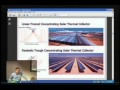
Comprehensive Guide to Concentrating Solar Thermal Power Technology
Explore the fundamentals, types, advantages, and challenges of concentrating solar thermal power (CSP). Learn about its suitability for desert regions, storage benefits, and integration with modern grids and desalination.

Understanding Solar Energy: An In-Depth Explore of Its Types and Impacts
Explore the significance of solar energy and its effects, along with types of pollution and leadership in sustainable practices.

Understanding Different Types of Solar Panels: Efficiency, Cost, and Uses
Explore the key types of solar panels—monocrystalline, polycrystalline, and thin film—and learn their unique features, advantages, and drawbacks. This guide helps you choose the right solar panel based on efficiency, cost, durability, and application needs.
Understanding Earth's Energy Balance and Solar Radiation
This video delves into the intricate details of Earth's energy balance, focusing on how solar radiation is absorbed, reflected, and dissipated. It explains the concepts of solar constant, incident angles, and the impact of atmospheric conditions on energy distribution, providing a comprehensive overview of the factors influencing climate and weather patterns.
Comprehensive Overview of Power Plant Engineering and India's Energy Scenario
This lecture provides an in-depth introduction to power plant engineering, focusing on India's energy scenario, fundamental thermodynamics laws crucial for power generation, major energy sources including fossil fuels, hydro, and nuclear, and details on energy consumption patterns across sectors and states. It also explains key concepts such as the Rankine cycle, laws of thermodynamics, and units of power measurement vital for understanding power plant operation and efficiency.
Most Viewed Summaries

A Comprehensive Guide to Using Stable Diffusion Forge UI
Explore the Stable Diffusion Forge UI, customizable settings, models, and more to enhance your image generation experience.

Kolonyalismo at Imperyalismo: Ang Kasaysayan ng Pagsakop sa Pilipinas
Tuklasin ang kasaysayan ng kolonyalismo at imperyalismo sa Pilipinas sa pamamagitan ni Ferdinand Magellan.

Mastering Inpainting with Stable Diffusion: Fix Mistakes and Enhance Your Images
Learn to fix mistakes and enhance images with Stable Diffusion's inpainting features effectively.

Pamamaraan at Patakarang Kolonyal ng mga Espanyol sa Pilipinas
Tuklasin ang mga pamamaraan at patakaran ng mga Espanyol sa Pilipinas, at ang epekto nito sa mga Pilipino.

How to Install and Configure Forge: A New Stable Diffusion Web UI
Learn to install and configure the new Forge web UI for Stable Diffusion, with tips on models and settings.

If you found this summary useful, consider buying us a coffee. It would help us a lot!