
Understanding SOHCAHTOA for Missing Angle Calculation
SOHCAHTOA is a mnemonic that helps remember the relationships between the sides and angles in a right-angled triangle:
- Sine = Opposite / Hypotenuse
- Cosine = Adjacent / Hypotenuse
- Tangent = Opposite / Adjacent
Before calculating an unknown angle, label the triangle’s sides relative to the angle:
- Opposite: Side opposite the angle
- Adjacent: Side next to the angle
- Hypotenuse: The longest side, opposite the right angle
Choosing the Correct Function
Based on the known sides:
- Use sin θ if you know opposite and hypotenuse.
- Use cos θ if you know adjacent and hypotenuse.
- Use tan θ if you know opposite and adjacent.
Using Inverse Trigonometric Functions to Find Angles
Since trigonometric functions relate angles to ratios, to find the angle when given a ratio:
- Calculate the ratio (e.g., opposite ÷ adjacent).
- Use the inverse function on your calculator:
- Inverse sine (sin−1 or arcsin)
- Inverse cosine (cos−1 or arccos)
- Inverse tangent (tan−1 or arctan)
Example 1: Finding Angle with Tangent
- Opposite side = 10 cm
- Adjacent side = 11.9 cm
- Calculate tan x = 10 / 11.9 ≈ 0.84
- Use inverse tangent: x = tan−1(0.84) ≈ 40°
Example 2: Finding Angle with Cosine
- Adjacent side = 1
- Hypotenuse = 3
- Calculate cos x = 1 / 3 ≈ 0.333
- Use inverse cosine: x = cos−1(0.333) ≈ 75°
Step-by-Step Summary
- Label the triangle sides relative to the angle.
- Identify which SOHCAHTOA function to use based on known sides.
- Calculate the ratio of sides.
- Use the inverse trigonometric function on your calculator to find the angle.
Mastering this process allows you to confidently find missing angles in right triangles using just side length information and a scientific calculator. For further study on how to determine side lengths in triangles using these concepts, see How to Find Triangle Side Lengths Using Trigonometry. Understanding these relationships also lays a strong foundation for Solving Varying Angle Problems Using Sine and Cosine Laws, which extends to non-right triangles.
To deepen your practical knowledge, explore techniques for Calculating Arc Length, Triangle, and Sector Areas with Theta, which make use of angle measures in circles and sectors. Additionally, mastering trigonometric inverses is complemented by learning Mastering Trigonometric Identities, Equations, and the CAST Diagram, providing a robust toolkit for trigonometric problem solving.
[Music] in previous videos we saw how to use socker to find missing sides in this
video we're going to look at how to use it to find missing angles before we start you need to know what soera stands
for and be comfortable using S cos and tan if you're not sure watch our earlier videos first let's jump straight in with
an example as always a soera start by labeling the sides as the hypotenuse adjacent and opposite so what do we
label the 10 cm and what do we label the 11.9 CM hopefully you thought the 10 cm is
the opposite because it's opposite the angle and the 11.9 is the adjacent because it's next to the
angle with opposite o and adjacent a should we use S cos or tan so we need to use tan So Tan angle
equals opposite / adjacent and substituting in our numbers we get tan x = 10 /
11.9 now this is the new part to get X on its own you cannot divide by tan to separate the tan and
the X we use inverse tan have a look at your calculator and it is above the tan button see that it's written as tan to
the minus one and is also called AR tan invers s and inverse cos are also here so back to tan x = 10 / 11.9 and to get
the X on its own we use inverse tan brackets 10 / 11.9 so we type that into the calculator and we get X =
40° give this question go pause the video work out the answer and click play when you're ready to check did you get
1.5° if you got it right and want to skip the explanation click here otherwise let's go through it
together as always with sakoa start by labeling the sides adjacent is here and hypotenuse so a means we use c c angle
equals adjacent divide by h questiones substituting in our values so we have cos x = 1 / 3 using inverse cos so x
equal inverse cause brackets 1/ 3 type into our calculator and we get X = 75° so from this video you should now
know how to use socker to find a missing angle when you already know two sides of the right angle triangle make sure you
lab the hypotenuse adjacent and opposite first and then use inverse s inverse cos or inverse tan to get the angle on its
own just remember that is the same as dividing by S or dividing by cos or dividing by tan
[Music]
SOHCAHTOA is a mnemonic to remember the ratios for sine, cosine, and tangent functions in a right-angled triangle: Sine = Opposite ÷ Hypotenuse, Cosine = Adjacent ÷ Hypotenuse, Tangent = Opposite ÷ Adjacent. It helps relate an angle to the sides of the triangle, making it easier to calculate missing angles when side lengths are known.
First, label the sides relative to the angle you want to find: opposite, adjacent, and hypotenuse. If you know the opposite and hypotenuse sides, use sine; if adjacent and hypotenuse, use cosine; if opposite and adjacent, use tangent. Choosing the correct function based on known sides ensures accurate angle calculation.
Calculate the ratio of the relevant sides as per SOHCAHTOA, then use the inverse trig function on a scientific calculator: sin⁻¹ for sine ratios, cos⁻¹ for cosine ratios, or tan⁻¹ for tangent ratios. For instance, if tan x = 0.84, compute x = tan⁻¹(0.84) to find the angle in degrees.
Step 1: Label the triangle sides relative to the angle (opposite, adjacent, hypotenuse). Step 2: Determine which function (sin, cos, tan) to use based on known sides. Step 3: Calculate the ratio of these sides. Step 4: Use the inverse trigonometric function on your calculator to find the missing angle.
SOHCAHTOA applies specifically to right-angled triangles. For non-right triangles, you need to use other methods like the Sine Law or Cosine Law, which handle varying angle problems. These laws extend the principles of trigonometry beyond right triangles to calculate unknown angles or sides.
Correctly labeling the sides as opposite, adjacent, and hypotenuse relative to the angle in question ensures you select the right trigonometric ratio. Mislabeling can lead to incorrect ratio calculation and thus wrong angle measurement. Accurate labeling is essential for applying SOHCAHTOA successfully.
A scientific calculator capable of computing inverse sine (sin⁻¹), cosine (cos⁻¹), and tangent (tan⁻¹) functions is essential. These inverse functions allow you to find missing angles from side ratios. Familiarity with entering these functions on your calculator enhances accuracy and speeds up problem-solving.
Heads up!
This summary and transcript were automatically generated using AI with the Free YouTube Transcript Summary Tool by LunaNotes.
Generate a summary for freeRelated Summaries
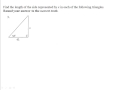
How to Find Triangle Side Lengths Using Trigonometry
Learn how to determine the length of a triangle's side using trigonometric ratios such as tangent, cosine, and sine. This guide walks through key examples and step-by-step methods to apply these ratios effectively, perfect for students mastering triangle problems.

How to Solve Right Triangles Using Pythagorean Theorem and Trigonometry
Learn step-by-step methods to solve right triangles by finding missing sides and angles using the Pythagorean theorem and trigonometric functions. This guide explains when to use inverse trig functions versus direct trig ratios with practical examples for clarity.
How to Use the Cosine Law for Solving Triangle Dimensions
This video tutorial explains when and how to apply the cosine law to solve triangles, especially in cases where the sine law is not applicable. Learn step-by-step methods to find unknown side lengths and angles using the cosine law with practical examples.

Understanding the Sine Law for Solving Acute Triangle Problems
This video explains the sine law specifically for acute triangles, demonstrating how to relate angles and their opposite sides to solve for unknown sides or angles. Through clear examples, it illustrates applying the sine law formulas and highlights key considerations such as angle-side pairs and rounding effects.

Understanding the Ambiguous Case in Triangles Using Law of Sines
This lesson explains the ambiguous case in triangle problems, where given information can produce two distinct triangles. It guides how to identify and solve these scenarios using the Law of Sines, with clear examples demonstrating step-by-step calculations.
Most Viewed Summaries

A Comprehensive Guide to Using Stable Diffusion Forge UI
Explore the Stable Diffusion Forge UI, customizable settings, models, and more to enhance your image generation experience.

Kolonyalismo at Imperyalismo: Ang Kasaysayan ng Pagsakop sa Pilipinas
Tuklasin ang kasaysayan ng kolonyalismo at imperyalismo sa Pilipinas sa pamamagitan ni Ferdinand Magellan.

Mastering Inpainting with Stable Diffusion: Fix Mistakes and Enhance Your Images
Learn to fix mistakes and enhance images with Stable Diffusion's inpainting features effectively.

Pamamaraan at Patakarang Kolonyal ng mga Espanyol sa Pilipinas
Tuklasin ang mga pamamaraan at patakaran ng mga Espanyol sa Pilipinas, at ang epekto nito sa mga Pilipino.

How to Install and Configure Forge: A New Stable Diffusion Web UI
Learn to install and configure the new Forge web UI for Stable Diffusion, with tips on models and settings.

If you found this summary useful, consider buying us a coffee. It would help us a lot!