
Introduction
In this comprehensive article, we will delve into the intricacies of Ampere's law, its application in solving complex electromagnetic problems, and explore concepts like magnetic fields, solenoids, and induced electromotive forces. Understanding Ampere's law is crucial for anyone looking to deepen their knowledge in electromagnetism, as it serves as a foundation for many real-world applications.
What is Ampere's Law?
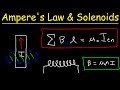
Ampere's Law is a fundamental principle in electromagnetism that relates the circulating magnetic field to the electric current flowing through a closed loop. The law states that the integral of the magnetic field around a closed loop is equal to μ_0 times the electric current that passes through the loop. Mathematically, it can be expressed as:
[ \oint B \cdot dl = \mu_0 I_{enc} ]
where:
- B is the magnetic field,
- dl is an infinitesimal length element of the path,
- μ_0 is the permeability of free space (a constant), and
- I_{enc} is the total current enclosed by the loop.
The Sign Convention
When applying Ampere's Law, it is essential to adhere to a specific convention when calculating contributions:
- Currents flowing out of the plane of the loop are considered positive.
- Currents flowing into the plane of the loop are considered negative.
This arithmetic nature of currents emphasizes the importance of direction and magnitude when performing loop integrations.
Magnetic Field Calculations with Ampere's Law
Current Loop Example
To illustrate Ampere's Law, consider the case of a straight wire carrying a steady current. Using symmetry and the circular nature of the required magnetic field around the wire, we can effectively calculate the magnetic field at a distance r from the wire. The formula derived from Ampere's Law is:
[ B = \frac{\mu_0 I}{2\pi r} ]
This indicates that the magnetic field is inversely proportional to the distance from the wire.
Solenoids and Magnetic Fields
A solenoid is a long coil of wire that generates a magnetic field when an electric current passes through it. The field inside an ideal solenoid can be calculated using Ampere's Law. The formula for the magnetic field inside an infinite solenoid is given by:
[ B = \mu_0 n I ]
where:
- n is the number of turns per unit length of the solenoid,
- I is the current flowing through the wire.
For practical, finite solenoids, while the ends will cause fringing effects that affect the magnetic field outside the solenoid, within the core, the magnetic field remains relatively uniform.
The Right-Hand Rule
To determine the direction of the magnetic field generated by current, one can use the right-hand rule. By curling the fingers of your right hand in the direction of current flow, your thumb will point in the direction of the resultant magnetic field lines.
Faraday's Law of Induction
Faraday's Law expands upon the principles of electromagnetism by describing how a changing magnetic field within a closed loop can induce an electromotive force (emf). The significance of this law lies in its ability to predict how changing magnetic environments affect electric currents. The relationship can be expressed as:
[ E = -\frac{d\Phi}{dt} ]
where:
- E is the induced electromotive force,
- dΦ is the change in magnetic flux,
- dt is the change in time.
Lenz's Law
The negative sign in Faraday's Law is a statement of Lenz's Law, which states that the induced current will flow in a direction that opposes the change in magnetic flux that produced it. This principle helps in anticipating the direction of induced current and magnetic fields, ensuring that the electrical circuit resists changes in energy state.
Practical Applications of Ampere's Law and Faraday's Law
Electric Generators
Understanding these laws is crucial in applications like electric generators, where mechanical motion (such as rotation) in a magnetic field induces current. A practical example involves dragging a wire loop through a magnetic field, causing the light bulb connected to the circuit to glow.
Electric Motors
Conversely, electric motors utilize the principles of these laws to convert electrical energy into mechanical energy, allowing for the movement and control of devices in various applications.
Conclusion
Ampere's Law and Faraday's Law serve as fundamental pillars of electromagnetism, explaining the relationship between electric currents and magnetic fields, as well as the induction of electromotive forces. Understanding these principles not only facilitates the analysis of electromagnetic systems but also enhances our grasp of real-world applications in technology. As we continue our exploration of physics, these concepts will be integral to advancing our understanding of electrical systems and their practical implementations.
Prof: Let's start. I told you about Ampere's law, which is key to what we are going to do next, so I'll remind you what the
deal is. It says, if you have a closed loop and around that loop you integrate the magnetic field that is equal to
μ_0 times all the currents that penetrate this loop. So some current would be going in, some current would be coming
out. The guys who are outside the loop don't contribute. Guys who are trapped inside this, they make a contribution.
That's Ampere's law. Now you have to know the convention. The convention is that you do the line integral
counterclockwise, and if your fingers are following the line integral, your thumb points towards outside the board, and that current is positive.
Anything going into the board therefore will be counted as negative in this one. So this has to be counted with sign, do you understand?
If the contour goes one way, all currents coming out of the board are positive, all those going in are negative.
In particular, if these 4 currents add up algebraically to 0, one is 2 amp, another is -2 amp and so on, then this integral will vanish,
even though there are currents. So it counts not the absolute value but the algebraic sum of all the currents.
Now there's another subtlety I didn't get into last time, which is the following - remember, this is the current penetrating a surface, bounded by this loop.
You guys with me on what that means? Now as long as I force you to put this loop and to live in the plane of the blackboard, there's only one surface with
that loop as the boundary. But in real life, we are doing stuff in three dimensions.
Imagine pulling this loop out of the blackboard. A lot of currents are coming and going out. What is the surface of which this loop is the boundary?
The answer is not unique. There are many, many surfaces that have the same loop as the boundary, right?
Take a piece of wire and wrap it in the form of this boundary and dip it in soap, and you pull it out, you'll get a soap filament.
That soap filament has as its rim, or the boundary, this loop. That may not even be planar.
And if you blow on it, it's going to bulge outside, right? Still this rim will be the boundary of that bulging
surface. So actually, even if the surface is coming out of the blackboard, the theorem is still valid.
So let me draw another picture that may be helpful. Suppose this is the surface and you've got all these currents, some going in and some coming out.
You may have imagined all this time I meant a flat planar surface. I don't.
You can imagine now a curvy surface, like maybe a hemisphere, of which this rim is still the boundary. You can ask, "How can that be?
Where do you want me to count the currents, here or on that surface?" The answer is, it doesn't matter.
It doesn't matter because any current coming in here has to get out also through the other one. The only--or it may come in and decide to come back here,
in which case it doesn't leave the other one, but it will make 0 contribution to this contour because it's coming in once and going out once.
Because currents don't terminate, just like magnetic field lines, whatever crosses this surface will also cross any surface with the same boundary.
That's a fact that will become important later on. So you follow that? The law, if you want to write it formally,
I'm going to write it as some surface, and this is the surface integral of the current density, which is the current per unit area.
And this loop is the boundary of that surface, and I told you that the boundary of any surface is written as partial S.
This is the correct way to write Ampere's law. And the point I'm making is, this could be any surface with that as the boundary.
Now once you've got Ampere's law, I was trying to show you how you can use it to solve certain problems that might have otherwise been difficult.
Just like Gauss's law. Remember, Gauss's law was very helpful when you took a solid ball of charge.
The electric field of that is usually hard to find, but from spherical symmetry, you know the field is radially outwards.
You draw a Gaussian surface and you know the field's magnitude is constant on a sphere. How big is it?
You get that from Gauss's law. So certain problems which are highly symmetric, you can get using Ampere's law also.
So one example I did, I want to repeat it, because one thing I said wasn't right. There's this current going from - to infinity,
and we want to find the field around it. If you do an honest calculation, you will say, let me take a segment, let me take a point,
let me join the segment to that point and take the cross product of the dl with the R, etc.
and so on, right? And it will give you a contribution coming out of the blackboard, but then you have to integrate it.
Now you don't have to do all that if you use symmetry. The symmetry argument would tell you first of all that any field configuration you have will be the same if you rotate
it around a circle. Because if you look at the wire end on and you turn the wire, it looks the same so the field configuration should look the
same. And I said there are only a couple of things that have the property.
Here's a good one. Maybe it does that. And the other one is this.
Here is the wire. Notice if you turn the wire, the wire looks the same, configuration looks the same.
If you turn this wire around its own axis, wire looks the same and the configuration looks the same. Then I said we rule this guy out, because magnetic field
lines cannot come and end at a point. Then I gave another explanation, which is that if you reverse the current, the field lines are supposed to
go outwards, but instead of reversing the current, if I grab it and turn it by 180 degrees around this axis, then the lines will still go in
but the current would be reversed. So for whatever reason, this is out and this is in. Then as to the direction of the field,
we also know that it has to be perpendicular to the blackboard, because the two vectors whose cross product determines it lie in the plane of the blackboard, so the field has to come out.
It has to come out and the amount by which it comes out cannot change as you go around the loop. And the answer can only depend on how far you are from the
wire. Then I write Ampere's law as 2ΠR times B at the radius r = μ_0 times the
current. In other words, I look at the wire from the end, and I take any contour I like of radius r.
Then since B is tangential to the circle, the line integral is simply 2Πr times B, and that's the current enclosed, so you find B.
If you like, B_ Φ, meaning in the azimuthal direction.
This angle is called phi. B_Φ = μ_0 I/2Πr.
That's the result we got from integration, but you can also get it from Ampere's law. Then I did another variation.
I definitely don't want to repeat that, which is, what if the wire is thick. Not a point wire but got finite thickness with current coming
out of the blackboard. What is going to be the magnetic field? Then the answer depends on whether you pick a contour like
this or a contour inside the wire. And if you do the two things, you'll find the field actually grows linearly inside, then falls like 1 over r
outside. Anyway, this is stuff I did near the end. But now I want to consider two new problems which I didn't
study last time. The first one is going to be very important, is the solenoid.
If you imagine on a tube you wrap some wire, and the wire is wrapped like this many, many times. And you want to find the magnetic field.
Now one loop we know produces a field that goes like this. You stack them up, you expect the field to go like that inside the coil, then sort of loop around and
come back outside the coil. What we want to find out is the strength of the field inside the coil, and also outside.
So the way you handle this problem, you've got to take an Amperian loop that looks like this. If this is the cardboard on which you wound that thing,
see what this wire looks like when you slice it vertically. That's the tube on which you wrapped it. I want you to slice it vertically.
On the left hand side, I've current coming in. On the right hand side--coming out of the board and right, it's going on, you guys see that?
Wrap it around the solenoid and slice it down the middle, then on this end, the current's coming out, on this end, the current's going in.
So I'm showing you the cross section of the tube. It looks like this. So first thing I want to argue is that the field outside does
not vary with distance, because if I took a loop like this--it's not a real loop; it's a mathematical loop on which I'm going to use Ampere's law.
I know the field outside is going to be coming down, but maybe it's weaker here and stronger here and that's what I'm going to rule out.
You know how we can rule that out? What would go wrong if the field was weaker here than here? Something to do with Ampere's law.
Well, let me explain. Suppose you go around this loop. Here B and dl are perpendicular,
so there's no contribution to B⋅dl. Likewise here. Here you have a B going one way and you have the same
B but the path is going the opposite way. Now these two have to cancel. These two have to cancel because there is no current
coming out of this. Because there's no current coming out, this line integral has vanished, therefore B
times that length and B times that length going the opposite way must be equal in magnitude. That means the B here must be as strong as the
B there. So B doesn't vary when you leave the wire. Well, I can keep on repeating this argument until I go all the
way to infinity, but I know B is 0. Therefore coming from infinity inwards, B is going to be 0 everywhere here.
That's only true for an infinite solenoid. If you take a finite solenoid, there will be lines coming in here.
For an infinite solenoid, is when the lines always go perpendicularly. See, in a finite solenoid, you sort of know the lines will
do this, right? They'll be perpendicular here, but they could be at an angle there.
But for an infinite solenoid, every portion looks like you are here. The lines are only vertical, they have no choice but to
vanish. So the flux actually goes out and returns on a sphere of infinity.
So we only have to find the magnetic field inside. So then you've got to do the right hand rule and the right hand rule tells you the magnetic field looks like that.
And the question is, how big is it? Once again, I want to argue that the magnetic field is constant inside the solenoid.
Now atleast now you should be able to guess what argument I will use. The argument will be, take an Amperian loop like this
one. The two sides, this and that, do not contribute because they are perpendicular to the field.
These two better make cancelling contributions. And that's going up and that's going down. For them to cancel, the strength of the field here
must be the same as the strength here. So we have a result of the magnetic field as some number inside and 0 outside and we're trying to find the one number.
This is going to be the case whenever you use Ampere's law to get anything. In the end, Ampere's law is a single statement about the
magnetic field. You can get only one piece of information from it. If you reduced your problem to the point where there's only one
thing you do not know, you can find that one thing. Here I've talked my way out of the field in this region and that region, and here it's constant, and it's got a known
direction. Only thing I don't know is, how big is it? To find how big it is, you can take a loop like this.
Let me take a loop like this one. Let me repeat that for you. So here is the current coming out and I want to take a loop
like this. I want the loop to have length l. So the magnetic field is some number B there which I
don't know. It is 0 on the outside and I never care about these sides because they're perpendicular.
So the line integral will be B times l.going up, nothing there, 0 times l.going down and nothing here.
That's the whole line integral, B⋅ dl.. That = μ_0 times the current crossing the loop.
Now here's where you should not make the mistake of saying there's a current I flowing in the wire and therefore it's equal to I.
Can you tell me what's wrong with that logic? Yes? Student: It's coiling around so you have to count the
number of coils. Prof: You understand that? First of all, if you just walked into the
class now, first of all, you're in trouble. Secondly, if you just walked into the class and you saw this picture and you knew all about Ampere's law,
did not know anything about solenoid, nothing, what will you do? You'll say, "Here's a loop, current's coming out.
I just count the current coming in." The fact that these guys all belong to a big solenoid and they wrap around is irrelevant.
All that matters for the Ampere's loop is how much amps are coming at me or going away from me. So the fact that they're all part of one gigantic loop is
irrelevant. So you've got to count the number of turns that got trapped in this length l.
So we use the symbol small n, which is the number of turns per unit length. Then it's going to be number of turns per unit length times
l. So that depends on how tightly you wound the coil. If you wound 100 turns per centimeter, well,
it's whatever, 10,000 turns per meter. Now one nice thing is that this l cancels. Again, I want you to think about why l should
cancel. Why shouldn't the answer depend on l? This happens even when you do Gauss's law, when you take some
surface, the details of the surface cancel out always. Yes? Student: >
Prof: More turns of the wire. But the more important thing is, the question that was given to us was a solenoid.
It had some number of turns. It had a certain current. And the answer should only depend on the current and how
densely it is wound. This l. was my own artifact.
The Amperian loop is not a real loop. I made it up. So the answer I get for B cannot depend on
whether I took that loop or that loop or that loop. They should all give the same answer. That's why the properties of the loop should cancel out and
you should get in the end a result that depends only on the intrinsic variables in the problem. So this is a very useful result.
That's why we draw a box around it. That means important. The field inside a solenoid is μ_0 times the
number of turns per unit length, times the current flowing to the solenoid. I'll be invoking this result all the time.
It's one of the few results I carry in my head. Normally I encourage you not to carry too much stuff in your head, but this guy's pretty helpful.
So here's another solenoid that people have, which is better than this one in the following sense. As long as you make a finite solenoid--in real life,
everything is finite--you will have this return flux. There's a trick by which you can keep all the flux hidden inside the tube, by wrapping the tube into a
doughnut. So take the long tube and glue the ends together, then you have a solenoid which is like a doughnut on which you
wrap the wire. I've shown you a few turns. So you wrap it all the way round and you come back and you
drive the current from here. Are you guys with me? The cross section of the doughnut can be circular,
it can be square. It doesn't matter what it is. Sometimes it even contains some metal or iron,
which I'm not showing you. It's fine. Even if it's an empty tube, you wrap the wire around it.
But now the flux lines go like this along the tube. So let me take a problem where the cross section is actually a square, in other words, it looks like this.
I cut the doughnut right there and I slice it and I look at it, and you have the flux lines doing that. That's the cross section.
So which way is the flux going? Well, you've got to figure out again with the right hand rule, the way I've shown the currents, if you do this around
the wire, the flux is actually going like that here. Our job is to find out what is the magnetic field inside that
doughnut. For that, I'm going to slice the doughnut the way you normally slice a doughnut.
You normally slice a doughnut so it looks like this. This is half the doughnut, okay? You cut it, then let's say the wire looks like that one.
That guy is coming in, coming out of the board, going into the board, coming out of the board, going into the board.
Yes? Can you see that? If you take a doughnut with a wire wrapped around it and you cut it, it's going to look like this.
Now the important thing to notice is that we haven't really cut that doughnut. If you really cut the doughnut, there's going to be no current.
This is a mental slice you make. Then you ask yourself, now what do you think is going to be the Amperian loop?
Can you make a guess what the loop will look like? Yes? Student: It will look like a piece of pie.
Prof: A piece of pie. We're all getting hungry now. I've talked about doughnuts.
Which pie? Student: It will have it so that the sides perpendicular to the-- Prof: Oh, okay.
Maybe you could do that, but here is what the general consensus, 9 out of 10 physicists use this contour. This is going to be the Amperian loop.
Then what can you say? The loop has some radius r, so once again, 2Πr times B is
μ_0I times the number of turns altogether in the solenoid. You understand?
Because this loop cuts through every turn of wire. As far as the direction is concerned, it will go like this. The field will go this way.
So the magnetic field here is μ_0IN divided by 2Πr. So the field actually gets weaker, so that if you cut this
doughnut, the field on the inner rim will be stronger than the field on the outer rim. And if you go inside the inner rim, you'll get 0;
outside the outer rim, you'll get 0 because any loop you draw on the contour will intersect an equal number of incoming and outgoing currents.
So B is going to vanish outside the doughnut, and it's going to be non-zero right inside the heart of the doughnut, and the strength will be this.
Now if this doughnut had a radius of say 1 light year, you can ask what will happen to the formula. You should be ready for what you expect.
Take a doughnut 10 miles long, 10 miles in circumference. What do you hope the formula to give? Yes.
Student: It should approach the results of the infinite solenoid. Prof: For infinite solenoid,
because the circle of radius 10 zillion miles, for most purposes, it's like a straight tube, right?
You cannot tell it's going around in a circle. Let's see if that happens. Well, you can see the field is μ_0NI,
divided by 2Πr is just the circumference of the circle. So it's going to be μ_0 little n
times I, because little n is big N divided by 2Πr. See that?
This 2Πr will-- in other words, you cut it here and you open it into a solenoid, its length will be 2Πr,
and the number of turns per unit length will be big N over 2Πr. But that's an approximation, because in a real finite
system, the magnetic field is not uniform. There's a slight variation from this end to that end. But if this thickness is 2 inches and that radius is 37
miles, that variation is negligible and it becomes that other easier result. Student: How did you get the small n again?
Prof: We got the small n because this guy. This is the total number of turns wrapped around the solenoid and 2Πr is the circumference,
right? So number of turns divided by the circumference will be the number of turns per unit length.
In other words, if it was a huge solenoid, so huge that it looked like a straight line to you from your range of observation, the number of turns it would
have per unit length would be exactly this much. So it will look like a straight solenoid to you, but it's curving around on a big scale.
All right, so this marks the end of one topic. So I'm going to write down over and over what we know, because I think I talked to some of you people,
and I asked you, what's the part you find difficult. And one thing I heard, which is very reasonable,
is the amount of stuff you're learning every day. This is just a lot of stuff. "Drinking out of the fire hose" was an expression
that came up. You drink and you drink and you drink and I keep throwing stuff at you.
I would like it to end. It's almost going to end, but it's not over yet. But I'll tell you where things stand now.
All of electrostatics and magnetostatics are summarized by the following equations. I'm going to write them again and again.
E⋅dA is the charge inside. Line integral of E⋅ dl.
or dr--I forgot what I called it--that is 0. Surface integral of the magnetic field is 0 because there are no magnetic charges.
The line integral of the magnetic field is mu 0 times all the current inside. That's it.
And the force--after all, who cares about E and B, except for this great equation, which tells you that if a charged particle goes into a
region with electric and magnetic fields, this will be the force acting on it. That's very important.
That's why we care about E and B, because they make things happen. So the cycle of physics will proceed as follows - this is all
for statics. That means J is constant and rho is constant. So somebody has to give you the currents and somebody has to
give you the charges. Then it's a purely mathematical problem to solve for the electric and magnetic fields.
And I was telling you yesterday a fact that may not be obvious, that these equations suffice to determine electric and magnetic fields, given the cause of electric and
magnetic fields, which is currents and charges. Okay, so now we are going to do--let me ask you something. When do we keep on modifying the equations?
I think I explained that to you. Why don't we stop now? Any idea why I'm going to modify the stuff?
Do you know? Do you know when we modify equations? What could be wrong with this equation?
Who can convince me it's wrong? Any idea? I'm not talking about a particular thing,
but I'm talking in general, what makes people modify their equations. Pardon me?
Student: New experiment. Prof: New experiment. That's the only reason you modify your results.
If these things worked, and it could have been a very consistent world in which it worked, but it is not the whole story.
At least one reason it's not the whole story is, rho and J are not always constant. You can have charges shaking around and you can have
currents. You turn them on and off as you wish. One thing is to hope that this continues to describe them even
in this situation. The fact that we derive them from steady currents and densities doesn't mean it has to fail when they are changing with
time, but there is no guarantee that they won't change. So I'm going to now lead you through the experiments that
forced us to change some of these equations. So these are called Maxwell's equations, but they're not the real Maxwell equations, because they're not valid for
the time dependent case. I'm going to start the phenomenon, then we'll see where the trouble begins.
So let's take a problem where I have a uniform magnetic field going into the board. This goes on forever, but it doesn't go beyond this
point. I've only shown you that much. Now I'm going to take a loop of wire like this.
It's got some width w and maybe some length l.. And I put a little light bulb here. Then I drag this to the right with some speed V. And
this magnetic field B going into the blackboard. Now if the loop is not moving, nothing will happen.
If the loop is moving, something does happen. Now I'm going to ask you what happens, because this is something you must know.
What happens when I drag the loop? Yes? Student: The light bulb will go on.
Prof: Good. The light bulb will go on is the answer that you've got to give.
You may not know by how much and whatnot. But first of all, why would I draw a light bulb if it's not going to go on?
That's how you should reason. That's how my kids did all their SATs. They asked extraneous questions.
One of them is, you put the light bulb because it's going to glow. So you can ask yourself, what's going on?
Why is the light bulb glowing? Is it some new physics? The answer is, whenever youwant a light bulb
to glow, you're looking for a battery. There is no battery in the circuit. And yet there is an emf, because every time a charge
makes one full turn and comes around, it has delivered some work, because that's what makes this thing glow.
You're constantly pumping energy into the resistor inside your bulb. And who's providing the energy?
These charges are going round and round doing some work. That means something is pushing them around this loop. We defined the emf to be the line integral of any force per
unit charge pushing them around the loop. This is per unit charge. That's got to be not 0.
So what is that force, and what is the emf is what I want to ask. Do you know what the force might be?
And why does it kick in only when I move the loop? Yes? Student: The force is the magnetic force that we
wrote. Prof: The v x B force. That's because there's a v here,
B into the blackboard. v x B looks like that. The force is v x B and it acts only here.
Let's understand why. If you come to this portion, if you take this v x B, this v is this way,
and B is into the board, v x B is perpendicular to the wire. But charges cannot go--even if there's a force perpendicular to
the wire, it doesn't contribute to the emf, which I found by going along the loop. So dr is along the loop.
The only way to get that to contribute is to have a force along the loop. That's only here and it's not here.
So the whole force is non-zero only in that segment. So its line integral is equal to simply the force, which is Bv times w.
That's the emf. Any time a charge goes around the loop once, that amount of work is being done.
Okay, so that explains it. We're not in any kind of trouble. In fact, we understand this problem completely without
bringing in any new stuff. But there's one paradox. We were told the magnetic field doesn't do any work.
You remember that? And yet here is a magnetic field pushing these charges and getting things done.
So what can be going on there? Student: It takes work to move the whole loop. Prof: It takes work to move the loop.
That is certainly true, but how about the fact that the magnetic field manages to do some work? Is that a problem for you or not?
Remember, the original argument for why it doesn't do any work is, the force is v x B and the power is the velocity times the force and it's 0,
because v x B is perpendicular to v. But here, v x B is this way, and the charge is moving this way.
It looks like we got some work done. Okay, so the answer is that this is not the full--there are two kinds of velocities.
If you have a current in the wire, the charges are also moving in the wire at some speed u. So the real velocity has got the velocity because the whole
loop is moving, v, and the fact the current is moving this way, u, and w, if you like, is the true velocity.
And v x B is actually in that direction. That is v x B, perpendicular to w. So let me draw the picture for you.
w and w x B. w is made up of two parts. It's got a part v here, it's got a part u here.
So the magnetic force is not just along the wire. It's really at this strange angle. And we can easily find out how much of the force is this part
and how much of the force is this part. The force here will be--let me see. It will depend on the other component, so it will depend
on--yes, the force here is B times v and the power is that times u. The power is Bvu, due to this portion.
But in this side, if you ask what's the power delivered by that component, it is B times u times v, but with a - sign.
In other words, if you resolve this w x B into two parts, the vertical force is due to the horizontal velocity, and the power is that times the
vertical velocity u. The horizontal force is due to the vertical velocity. That's how the cross product works.
So when you're done, both are equal to B times u times v. But this is and this is -.
In other words, in the end, it would like to move the charge this way, because that's the force, but it manages to move it along the wire this way.
It would like to move it this way, but it's force to go oppositely. So a force trying to move this way, this part it is doing work,
but this part it is not doing work. It has work done on it, because we forced the electrons to move to the right.
Of course, that energy comes from the person pulling the rod, pulling this loop, because every charge that has this force, it won't just move unless you
pull it, and the force you apply is really coming from you that balances the magnetic force. So there's yet another force.
That's the force due to me, and I'm pulling this to balance this part of the force. So what is the role of the magnetic field?
It doesn't do any work, but you need it here, because one component of the magnetic field does work. The other component has work done on it.
So it takes with one hand and gives with the other hand, but you need that. It's no used saying, "I'm not very impressed
because I did all the hard work." You did all the hard work by grabbing this loop and pulling it, but I challenge you to go and
push the individual electrons so they can move down the wire. You cannot even see those little guys, right? But the magnetic field does that for you.
So it takes macroscopic mechanical power, turns into microscopic energy supplied to the electrons. Even though the field did not profit in the end,
it just delivered to the electrons what you gave them, you need that field to do a transfer from something you can see and pull to something you cannot see,
right? I mean, I give you a light bulb and you've got all the muscles in your hand.
Let's see you make it glow. You cannot say, "I have the energy." There's no way to transfer it.
That's the role of the magnetic field, so you shouldn't say it's no use. Anyway, we got that answer.
I'm going to give you another equivalent way to explain the balance of energy. We all know that the energy is coming,
because once the loop carries a current, it's going to be hard for you to pull the loop, so you've got to do some work, and that will explain the power
usage here. So let's calculate the power two ways. The power in the resistor = emf squared over R.
emf squared is B^(2)v^(2)W^(2)/R. Now how about the power that I provide? What's the power I provide?
I'm pulling this leg of the wire here. The force on anything, you remember, is BwI, and I pull it with a force
v, with a velocity v. That's the power. So it is Bwv times I.
I = emf divided by R. But if you put the emf that we just got, you will get this. So they will match.
So do you understand how this thing works? This is a generator, if you like. If you want to light the bulb in your house,
one option is to set up a magnetic field, take the light bulb and connect it to a rectangle, and grab it and keep running.
As long as you're running, the light bulb will be glowing. When do you think it will stop glowing? Yes?
Student: I'm sorry, what does that word say? Prof: This one? The power that I provide.
Okay, I'm just balancing the power loss in the resistor. Are you with me now? You understand the two things?
I take the force I apply on the wire, multiply by the velocity with which I pull. That's the power.
Likewise I take I^(2)R. That's the electric power dissipated. And of course, they balance.
Notice that once the loop is fully inside the magnetic field, the light bulb will stop glowing. Do you know why?
Can you see why? Yes? Student: Because the flux in the loop isn't changing
any more. Prof: No, no. You're pulling new laws, in terms of what I've told you.
Student: The magnetic field, there's no new field coming through the wire. The field is constant that's coming through the wire.
Prof: Just use what we've used so far. Yes Student: The field is acting on the left segment.
Prof: Right. In other words, without invoking any new ideas, once this piece gets into the loop, it's going to have a
v x B there and a v x B there. Which way should the current go? In fact, it won't go anywhere, because the line integral of
this will be 0. You will get contribution from there, and - the contribution from there.
So we can demolish this problem. You understand it completely. It doesn't pose any difficulties.
And it does not give any grounds to monkey with those equations. And now comes the bad news.
Suppose I go to a frame of reference moving with the loop. It may well be that the loop was just there, and I hired a couple of guys to carry a magnet and run under my
house, right? And also, my light bulb will glow, and I don't have to go anywhere.
They will carry the magnet. Now you realize that you're certainly entitled to see it from that frame of reference.
Now if you believe in relativity, that means a person should be able to say from the point of view of the loop, "I'm not moving.
Someone's carrying the magnet and running with it." But the light bulb must glow. Lots of things are relative, but whether a light bulb is
glowing or not is not relative. You can go to any frame of reference. A glowing light bulb is a glowing light bulb.
We don't know how much power it consumes and so on, but the fact that it's on and glowing is undeniable. So how is the person in that fixed loop supposed to
understand the glowing of the light bulb? What do you do, what do you say, in terms of anything?
Why are charges going around? I'm a static loop. Okay, someone's moving with the magnet, but there's no v
x B force because nobody's moving in my loop. The magnet's irrelevant. Of course, there's one difference.
This magnet is not like the usual problem, because it's a changing magnetic field, whereas previously you had a static magnetic field.
So you might say, "Well, maybe the force on a charge due to moving magnetic field is different from its force due to changing magnetic field."
But that's not acceptable, because if you believe in the reality of the field, what it does at a given point depends on its value.
It doesn't depend on anything else. But I still haven't explained why charges like to go around a wire now.
So what force could be pushing them? What force do you think will push them around a loop? Yes?
Would you like to guess? Yes, you. Student: >
Prof: The magnetic field is changing with time. You agree that the loop is going to be fixed, and a little later, it will look like this,
and so on, right? But that's not going to move the current around the wire, because the magnetic field has no cross product with anything.
So what's the only thing that can make the charges move around the wire now? What made them move in the DC circuit?
Student: Electric field. Prof: Electric field. Look, I want you to understand that these equations carry a
large amount of information, and they in fact carry everything as far as you need to know. The only force on a charge is either E or v x
B. That's it. If v x B is out, it's E.
I mean, there may be brand new phenomena. It turns out that we don't need anything else. E and B will do.
In which case, what are we saying? We are saying that in the other frame of reference, where the loop is fixed and the magnet is moving,
there is an electric field. Not only that, it's an electric field whose line integral is not 0, because it is still true that
charges in the loop are going round and round and doing work, and someone's providing work for every charge that goes around the loop.
And the emf is the work done on a unit charge. So this makes us believe now that whenever there's a changing magnetic field, there is an electric field.
This is an electric field of brand new origin. All the electric fields you studied before were produced by charges, by coulombs force.
This says, without the help of any charge. Charges are nowhere to be found. They could be infinitely far.
If I change the magnetic field, I'm going to get an electric field. Of course, we have to find out what is the connection.
How much electric field do you get? How is it connected to the magnetic field? These are things you have to deduce and you cannot deduce
them from logic. You can deduce them only from experiment. Certain things come from logic.
If you have an equation, you solve it using mathematics. If you like, that's a kind of logic. Or you use symmetry and say, "If I turn the wire and it
looks the same, the answer should look the same" and so on. But what electric field should be produced by changing magnetic
field you cannot derive from pure logic. If you combine it with other principles like relativity, you could try to get them, but right now,
with what we have, we just know that in the moving frame-- look, you don't need Einstein to tell you this.
Even before Einstein, you knew that you're certainly free to imagine a loop being fixed and somebody moving the magnet.
And everything in you tells you the answer's got to be the same, because in the end, it's the relative motion between the loop and the magnet that decides.
And if you provide the same relative motion, you've got to get the same answer. And the only way to get that is to say when there's a changing
magnetic field, I have an electric field, and furthermore, electric field which is no longer conservative because its line integral is not 0.
So we've got to find out what it is. So I'm going to tell you now an equation that really answers that question, and we cannot derive it.
It's a summary of a lot of experiment. And that says that the electromotive force-- in fact, due to electric and magnetic origin,
em = -d Φ/dt, and I'll tell you what this equation means. So you take a loop, some contour c,
and you define Φ to be equal to the integral of the magnetic field on a surface whose boundary is this loop. That's called the magnetic flux.
So you know operationally how to calculate it. Take any surface you want. It may be a flat one, a bulging one,
doesn't matter. Take the flux going through any surface with that as the boundary, and find its rate of change, and that will be equal
to the electromotive force. In fact, you just write E electromotive force, = -d Φ/dt.
So you know operationally how to find this thing, right? Now again, you may ask, "Which surface do you want
to take for a given loop?" This flat one or the curvy one or the one with more bumps in it?
The answer is, again, it does not matter. The reason is the same. If you've got some magnetic lines coming through this guy,
they also have to come out through that guy because they don't stop. Magnetic field lines that enter one surface have to also enter
another one with the same edge, because they cannot escape. So you can take any surface you like. So whenever you have these laws where a surface is invoked,
and it's ambiguous and not defined by the perimeter, the answer is, it doesn't matter which surface.
The reason is that field lines don't stop and end, therefore whatever enters this surface has to leave this. If you had magnetic monopoles, the lines can enter this and
terminate on a negative monopole, then of course it won't be true, but you don't have that. Now this - sign has got the name Lenz attached to it,
and this thing is called Faraday. Faraday and Lenz. And I will tell you what the - sign due to Lenz means.
Lenz's law tells you that if you change the magnetic flux in a system, there's going to be a very long sentence. If you take the magnetic flux in a system and it changes,
it will induce an emf which, if it could drive a current, will do so in order to fight that change. That's why it's a long statement.
In other words, if you had a real circuit and you shove it into region of changing field, an emf will start driving a current.
That current itself will produce its own magnetic field. Which way will it point? The answer is, it will point it such a way as
to neutralize the change. For example, if you took a loop and it had some flux going through it, if you tried to increase the
flux going through it, it will try to decrease it, so the current will flow like that. If you try to decrease the flux through it, it will try to prop
it up to its old value. The current will go like that. That helps you find the direction of the current.
The emf will be such as to neutralize the change. It does not necessarily oppose the external field, the magnetic field.
It opposes the change in the magnetic field. That's what I want you to understand. For example, suppose I've got lines coming
out here. And they get weaker, namely some source of magnetism makes the lines weaker.
Then the current will start going this way to prop up the thing back to its old value. That's what you have to understand.
That's the meaning of the - sign and that's going to guide us much better than all the cross products. Now I will show you that with this one law,
you can explain everything. In other words, you can explain the wire, the current loop moving in the magnetic field,
in the laboratory frame, in which the magnet was at rest and the loop was moving, or in the loop frame, where the loop was at rest and the magnet was moving.
You can explain everything with this one great law. It's a remarkable law. And you just have to say, we got it from experiment.
I'm going to tell you how it explains everything. So let's go back to this loop. By the way, some of you gave that answer, so it was not the
wrong answer. I mean, I think it's perfectly valid, except that I did not want you to use something we had not done
yet, but from this moment on, it's a valid answer. So I'm going to give you the other explanation.
So here is my field. I think I had everybody going in, right? Here is the thing-- so I want you to know what I'm trying to
do now. I'm trying to tell you that this one law will explain the loop going through the field in both frames of reference.
So first I'm going to do the easy part. When there's a fixed magnetic field and I'm dragging the loop. I'm not going to worry about and - signs, because I will get
that in the end. Let us ask, what is the flux penetrating this loop? Can you see that it's just the magnetic field times the width
of the loop times the length of the loop that is inside? Not the whole length, but the length of the loop that is still inside the magnetic field.
That's a very simple result. B times A is the flux. Now let's take the time derivative of this,
dΦ/dt. B is not changing, w is not changing, but l is changing, because when I move the loop,
the rate of change of l is just the velocity of the loop. But that's exactly the emf we got before.
Now the only thing is with the - sign, let's figure out if the sign is correct. This has got magnetic flux going into the board.
When you pull the loop to the right, you've got less magnetic field going into the board. Therefore the current should flow in such a way as to
continue the flux. So which way should the current flow? So if I'm pulling the loop--I'm sorry.
I've got the loop drawn backwards. This is okay too. Let's take this loop and pull it to the right with a velocity
v. So the flux into the board is increasing, right? So it should produce flux coming out of the board now to
compensate that. That means the current has to flow like this. See that?
When the current flows like this, you'll start producing upward flux. In other words, you're getting more and more
flux into the loop going into the board. To cancel it, I will produce flux coming out of the board.
That's what the loop tells you. That way you don't have to worry about all the cross products.
At the very end, you ask what's happening to the flux? How do I keep it from changing?
And the answer is, you keep it, in this case, from changing by producing flux coming out of the blackboard.
And finally, remember when the loop is entirely inside, there's going to be no more emf, because the flux through it is not changing.
Because in the beginning, as it moves to the right, it's gaining more and more flux from the back end of it, but once it's fully in, it's not getting any more flux,
so the current will stop flowing. That comes from this argument, from this way of thinking, that dΦ/dt
is 0. So in other words, I've given you something that I say is a new law.
The law says the rate of change of flux = emf, but so far, it doesn't look very new, because everything it gave you, you were able to get without
this law, right? We managed to understand the loop completely. So is there any new information in this?
And that's what I'm going to talk about. The new information's going to come in when I eventually use it to understand the answer in the moving frame of reference,
namely, what's the electric field produced by changing magnetic field? That's also contained in this one.
But I'm just telling you, this part of it is a letdown, because it's not very impressive. It gave you an emf you can get from the v x B.
It is just v x B all over again. But let's see what is new. To really find what is new, we have to take this problem
and apply it to the very general case of a loop. Here is some loop. I'm going to have the loop actually move in time.
Take a loop in one shape. A little later, it's got another shape. And the magnetic field is free to change.
I'm going to take a very general situation. The loop is moving, field is changing. So let's say this surface is S_1 and a
little later there's a surface S_2. You should imagine this is stacked on top of this. Maybe I should hide that part.
Here is this surface, and it's moved to a new location. Now this surface, let me call S and let me
call S Δs and you will see what I mean by S ΔS. You can build up that surface by taking this surface and
gluing to it this edge. Is that clear or not clear? Not clear.
Let me take a simpler surface than this one. Here is a surface, here is another surface. So one is a cylinder with the round sides on the bottom.
The other is the top. Do you agree, they are both surfaces with the same boundary?
Are you with me there? This top loop can either take the top of the cylinder as its boundary, or it's a hollow cylinder,
the curvy side and the flat bottom, are also another surface with the same boundary. But I can think of the second surface as essentially the old
surface the sides. So you agree that S' = S ΔS, where delta S is the stuff you glue on the side to
the old surface to make up the new surface. Yes or no? I think the cylinder is the easiest one.
I tried more ambitiously to draw this, but here is the simpler case. So now the question is, what is the rate of change of
flux in this problem? So the rate of change of flux I'm going to find as follows. I'm going to find the flux at time t Δt - phi at
time t. That's what I want. Now at time t Δt, my loop is here,
but I'm going to use, rather than that surface, I'm going to use the old surface the patch job to make it into the new surface.
So therefore, I want the magnetic field, B at t Δt on the surface S ΔS - the integral of the magnetic field,
dA on the old surface at time t. This part is quite subtle and it took me a while, when I first learned it, to understand what the point
was. See,the surface used to be the bottom half of the cylinder, the bottom plate.
The new surface is the top plate. So natural instinct will be, let's find B⋅v as on the top face,
but we don't want to do it that way. We purposely want to take another surface with the same boundary, because we're allowed to.
That is the old boundary the vertical sides. That's the main point. You take the old boundary because it's going to make it
easy for you to cancel some of the stuff with some of this. That's why. So B(t Δt) ⋅dA,
you can write it as B(t Δt) ⋅ dA on S integral B(t)⋅ dA on ΔS.
In other words, the surface integral is changing for two reasons. The surface itself, the loop itself around which
you take the line integral is changing, and the fields themselves may be changing with time. So they can both contribute to the change.
And I've broken up into two parts. One says take B at time t Δt on the same old surface, and then take
B⋅dA on the incremental surface, and subtract from it B(t)⋅dA on the old surface.
So do you guys see that? Phi of t Δt I've written as two parts. One is the flux on the lower face, but at a later time,
and the flux on the curvy sides. Now on the curvy side, you don't have to worry about whether it's at a later time or at an earlier time,
because ΔS is first ordered in time. It's proportional to Δt, and this difference is going to be proportional to
Δt, so you don't have to worry about the change in time over an infinitesimal surface, because that's second ordered in time.
So now I have to bring all that stuff over here. So I'm going to say the change in Φ = dB/dt times dA, Δt on the old
surface, here is the stuff we have to do that's extra. So do you understand how I cancel B(t Δt) −
B(t), that's given by the rate of change of B with time, times the change in time? You get their contribution only because B is changing
with time, because you're taking the very same surface, as you did the first time, but at a later time.
Therefore the difference is due to the rate of change. But now we have to do the second part, which is, on the surface Δs, we want to take
B⋅dA. Now what is ΔS? Let me see.
So I will have to draw the picture like this. So here's one surface, here's another surface,
and I've gone from here to here. I've gone from this loop to this loop in a time Δt.
This is my segment of the loop, and that's the distance, vΔt. So the area vector associated with this section is just
vΔt x dl. That is the surface area. You see that?
A parallelogram formed with the loop size dl here and the distance traveled in dt. Area of that is just the cross product.
So this = 1 v (I'm going to put the Δv outside) v x dl⋅B. So I'm not going to touch this expression.
I'm going to fiddle with this for a while. Cancel dt everywhere if you like, divide by dt. Forget that and forget that.
Then I get dΦ/dt = dB/dt ⋅dA on the surface, the line integral of v x
dl⋅B. Do you understand the last part what I did? The extra surface that you got here is made up of little
rectangular tiles with the one end being dl, other end being Bdt. The area vector comes like that, the magnetic field may
look like that, and the dot product of the two is what I have as the extra flux coming out of the curvy side of the surface.
Now you should know enough about cross products to know that this cross product is the same as dl⋅B x v,
because you can rotate the factors in an A x B⋅C is B⋅C x A, is C⋅A
x B. I've done that once. But then this = - the integral dl
⋅v x B. So I'm going to write down what I have. What I have is that the rate of change of flux,
dΦ/dt = -dB/dt times the area - integral v x B⋅dl. I'm sorry, it's d/dt that.
Therefore −d Φ/dt, we'll have a - sign here and a sign here. So just write the formula for −d
Φ/dt. Put a - on everything here. This is what I want you to know.
Now you've got to go home and you have to think about this. I don't claim it's easy. I will also tell you something.
If you really don't want to know everything, you don't have to follow this particular detail. I'm going to tell you what I get out of this.
That's what you have to know. I want to make sure that if you want to follow everything, you're given a chance.
So here's what I get from the old Faraday and Lenz law. This says that rate of change of flux has two parts. You take a contour and you find the flux changing through it,
it's got two parts. One, because the field itself is changing over the region. Second, because the loop itself is changing.
And together, they make these two contributions. But emf = - integral of all the electric forces and the magnetic
forces. That's = -(dB/dt)dA integral v x B⋅dl.
Now here's something very beautiful to look at. It says the rate of change of flux by miracle manages to measure the line integral of the electric field and the magnetic
field. And the rate of change of flux contains two parts. The second part is really the v x B force that
comes because the contour itself is moving, the wire itself is moving. So you balance this term with this term.
If this is all you were looking at, there's nothing new in the equation. That's why I said we're not impressed, because it's just the
v x B. But the real beauty is, when you cancel these terms and you look at what it says here, that says line integral of
E⋅dl = - rate of change of B⋅dA. The meaning of the partial derivative is that B can
depend on x, y, z, and t, but this is only due to change in t. Only due to change in t because I did the integral on
the same surface, only a little later. This is called Faraday's law. You can see that because of Faraday's law,
one of the four equations I wrote hidden somewhere here, in which the line integral of E is 0 is no longer 0. So this finally tells you that in general,
if you take the line integral of the electric field around a closed loop, you will not get 0 if the magnetic flux through that loop is changing.
But this has nothing to do whatsoever with a real conducting loop any more. See, this formula has a lot to do with the conducting loop,
because v is the velocity of the portion dl, as the loop moves through space. But the loop has been banished from the two sides.
These equations have nothing to do with any loop. They just say take a fixed contour in space and the line integral of E on that contour is the rate of change of
flux. It's an intrinsic relation between electric and magnetic fields, not having anything to do with conductors.
It's a property of E and B, namely that a changing B can produce a circulating E. That's the content of this equation.
Heads up!
This summary and transcript were automatically generated using AI with the Free YouTube Transcript Summary Tool by LunaNotes.
Generate a summary for freeRelated Summaries
Understanding Faraday's Law and Lenz's Law: A Comprehensive Guide
Explore Faraday's law, Lenz's law, inductors, and electricity generation in our detailed guide for physics enthusiasts.
Understanding Ampere's Law and Magnetic Fields in Solenoids
This video explains Ampere's Law, detailing how electric current generates magnetic fields, especially focusing on long straight wires and solenoids. It includes step-by-step calculations for magnetic field strength and offers a practical example to reinforce key concepts.

Understanding Magnetism: Forces, Currents, and Magnetic Fields
Discover the principles of magnetism, how currents create magnetic fields, and the forces involved, explained in simple terms.
Understanding Faraday's Law and Electromagnetic Induction: Key Physics Concepts Explained
Explore the fundamental principles of Faraday's Law and electromagnetic induction through detailed explanations and engaging demonstrations. This summary covers the relationship between changing magnetic fields and induced electromotive force (EMF), Lenz's Law, the significance of magnetic flux, and the non-intuitive nature of non-conservative electric fields in circuits.
Comprehensive Guide to Magnetism: Magnetic Fields, Forces, and Applications
Explore the fundamentals of magnetism, including magnetic fields created by bar magnets and current-carrying wires, magnetic forces on charges and loops, and practical calculations like forces between wires and torque on coils. Understand key principles and equations with detailed examples and problem-solving techniques.
Most Viewed Summaries

A Comprehensive Guide to Using Stable Diffusion Forge UI
Explore the Stable Diffusion Forge UI, customizable settings, models, and more to enhance your image generation experience.

Kolonyalismo at Imperyalismo: Ang Kasaysayan ng Pagsakop sa Pilipinas
Tuklasin ang kasaysayan ng kolonyalismo at imperyalismo sa Pilipinas sa pamamagitan ni Ferdinand Magellan.

Mastering Inpainting with Stable Diffusion: Fix Mistakes and Enhance Your Images
Learn to fix mistakes and enhance images with Stable Diffusion's inpainting features effectively.

Pamamaraan at Patakarang Kolonyal ng mga Espanyol sa Pilipinas
Tuklasin ang mga pamamaraan at patakaran ng mga Espanyol sa Pilipinas, at ang epekto nito sa mga Pilipino.

How to Install and Configure Forge: A New Stable Diffusion Web UI
Learn to install and configure the new Forge web UI for Stable Diffusion, with tips on models and settings.

If you found this summary useful, consider buying us a coffee. It would help us a lot!