
Introduction
In the dynamic field of economics, understanding key concepts such as scarcity, opportunity cost, and economic growth is essential. In the previous segment, we learned that scarcity forces individuals and economies to make choices, leading to opportunity costs - a fundamental principle illustrating what is sacrificed when one alternative is chosen over another. This article delves deeper into the significance of the Production Possibilities Frontier (PPF) and how it serves as a visual tool for these concepts, including underemployment and productivity.
Understanding Scarcity and Opportunity Cost
The Basics of Scarcity and Choice
Scarcity is an inherent characteristic of all economic systems, where resources are limited against unlimited wants and needs. When faced with scarcity, individuals and businesses must prioritize which goods and services to produce or consume.
- Scarcity leads to choice. When resources are insufficient to satisfy all desires, decisions must be made at every level.
- Opportunity cost arises from these choices, representing the value of the next-best alternative that is forgone.
For example, if a factory has the resources to produce 1 more widget, but doing so means it cannot produce 2 gadgets, the opportunity cost is the 2 gadgets that could have been manufactured.
The PPF as a Visual Tool
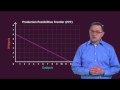
The PPF graph illustrates the maximum potential output of two goods given fixed resources, helping economists understand the relationship between scarcity and opportunity cost. The curve delineates the production limits of an economy.
Points Within the Frontier: Underemployment
The Concept of Underemployment
A point inside the PPF curve indicates underemployment of resources. This signifies that an economy is not using its resources efficiently, with production levels falling below potential output. Reasons for underemployment include:
- Recession: Economic downturns lead to reduced production and job losses, causing available resources, such as labor and machinery, to remain unused.
- Inefficiencies: Some economies may fail to reach their production capabilities due to systemic issues or poor resource allocation.
Movement Towards the Frontier
When an economy improves its functioning and moves from a point of underemployment toward the frontier, it indicates an economic expansion. This movement signifies a recovery phase in which resources begin to be fully utilized, thereby increasing overall production.
Shifts in the Frontier: Growth Factors
Factors Leading to Shifts in the PPF
The frontier itself can shift in response to two primary factors:
- Changes in Productive Resources: An increase in the workforce or acquiring additional resources can expand the frontier outward, allowing for higher production potential.
- Technological Advances: Innovations improve productivity, enabling the same resources to produce more outputs.
Example of Technological Change
Consider Fred, a factory worker:
- Before a productivity boost: produces 2 widgets/hour.
- After learning to use advanced tools: produces 3 widgets/hour.
Fred's increased output exemplifies how technology and human capital investments enhance productivity.
Economic Growth and Productivity
Definition and Importance of Economic Growth
Economic growth refers to a sustained increase in an economy's production capabilities, represented by an outward shift of the PPF.
- Result of productivity improvements: Enhanced worker performance enables greater output without necessitating additional resource inputs. This advancement permits economies to produce more of both goods, contrasting with static production conditions where increased output of one good implies a decrease in another.
- Why Growth Matters: Economic growth is vital as it allows economies to meet the evolving desires of their populations, facilitating improvements in living standards over time.
Conclusion
In summary, understanding the concepts of scarcity, opportunity cost, and their visual representation via the Production Possibilities Frontier is crucial in economics. This comprehensive look at how these concepts interact reveals the broader implications for underemployment and economic growth. As we explore further in future lessons, we’ll continue to uncover how these elements shape overall economic health and productivity trends.
Stay tuned for part 3 of this series, where we will delve into additional economic lessons that will enhance our understanding of these foundational concepts.
In the previous segment, we learned that scarcity forces people to make a choice, and when people choose, there is an opportunity cost.
Opportunity cost is the value of the next-best alternative when a decision is made; it's what is given up. The opportunity cost of producing 1 more widget
is the lost opportunity to produce 2 gadgets. So, the PPF can be used to illustrate two very important economic concepts--scarcity and opportunity cost.
Now, let's move beyond the basics and see how the PPF graph illustrates some bigger economic ideas.
This space right here, on the inside of the frontier, helps illustrate our next lesson. LESSON 3: A point inside the frontier
represents underemployment; movement back toward the frontier reflects economic expansion. The frontier represents maximum production
with the available resources, but it isn't just the points along the line that are production possibilities: Econ Isle could alternatively produce
at any point inside the frontier. So, while it could produce 4 gadgets and 4 widgets, it might produce only 2 gadgets and 2 widgets.
In this case, Econ Isle would not be fully employed, or put differently, resources in Econ Isle would be underemployed.
In fact, any point inside the frontier represents underemployment, which is a failure to reach full employment.
Why would an economy produce below its potential? Well, it could be in a recession, which is a significant decline in general economic activity
extending over a period of time. During a recession, Econ Isle's production will likely decline, resulting in workers losing jobs and leaving other
resources--machines and factories--underutilized as well. When economic activity picks up again,
production levels would likely move back toward the frontier. That is, the economy would move toward full employment. The shift from recession toward the frontier
is sometimes called an economic expansion. So far, we've talked about Econ Isle's possibilities up to its frontier, but the frontier line itself can shift.
Two primary changes can cause the frontier to shift: a change in productive resources and technological change.
Remember that the frontier reflects the available resources. The frontier will shift as the economy acquires or loses
productive resources. For example, if the labor force grows and other resources levels stay the same,
the frontier will shift outward. Or, if an economy diverts resources to produce more capital goods, which
means they are using economic resources to make other resources, the frontier will shift outward. Technological change is an advance in overall knowledge
in a specific area. The gains achieved through technological change tend to be gains through increased productivity--or an increase
in economic output per input. In fact, productivity is measured as the ratio of output per worker per unit of time.
Take Fred, for example. Imagine Fred can produce 2 widgets per hour, but then his productivity improves
and he can produce 3 widgets per hour. Notice that there is still only 1 Fred, and we are still measuring his production per hour,
but his output has increased. Two factors can increase worker productivity over time: investment in physical capital, things
such as computer software and tools, and human capital. Human capital is the knowledge and skills that people obtain through education, experience,
and training. Imagine Fred's hand tools were replaced with new power tools. All of a sudden Fred would be able to produce more output
in the same amount of time. His increase in productivity would be due to investment in physical capital.
And then when Fred learns to use the new power tools more effectively, he'll likely increase his productivity even more!
This increase in productivity would be due to investment in human capital. Increasing the productivity of workers
allows for more production without an increase in resources. And improvements in productivity will
shift the frontier outward, which illustrates our fourth lesson. LESSON 4: An outward shift of the frontier
reflects economic growth. Fred increased his productivity by learning how to use new tools.
Increasing the productivity of workers allows for more production without an increase in resources.
And improvements in productivity will shift the frontier outward which reflects economic growth. For Econ Isle, an outward shift can
mean that it can produce both more gadgets and more widgets. Notice that I said the economy could produce more of both goods.
Remember that when the PPF is static, producing more gadgets means producing fewer widgets--there is an opportunity cost.
But when the frontier shifts outward, it is possible to produce more of both goods. Economists call this economic growth,
a sustained rise over time in a nation's production of goods and services. Economic growth is important because it allows more people
to have more of what they want over time. Be sure to watch part 3 of this series to learn our final lesson, and we'll wrap up this episode.
Heads up!
This summary and transcript were automatically generated using AI with the Free YouTube Transcript Summary Tool by LunaNotes.
Generate a summary for freeRelated Summaries
Understanding the Law of Increasing Opportunity Cost in Economics
Explore the law of increasing opportunity cost and how it shapes production decisions in economics.

Understanding the Production Possibilities Frontier (PPF) and Its Economic Implications
Explore the Production Possibilities Frontier (PPF) through the case study of Econ Isle and its limited resources.
Understanding Alfred Marshall's Economic Theories and Their Impact on Price Determination
Dive into Alfred Marshall's theories on elasticity, consumer surplus, and the role of time in price determination.

Understanding GDP: A Comprehensive Guide to Gross Domestic Product
Explore the fundamentals of GDP, its significance, and implications for economic growth.

Understanding the Circular Flow Model in Economics
Explore the circular flow model and its significance in understanding economic interactions and relationships.
Most Viewed Summaries

A Comprehensive Guide to Using Stable Diffusion Forge UI
Explore the Stable Diffusion Forge UI, customizable settings, models, and more to enhance your image generation experience.

Kolonyalismo at Imperyalismo: Ang Kasaysayan ng Pagsakop sa Pilipinas
Tuklasin ang kasaysayan ng kolonyalismo at imperyalismo sa Pilipinas sa pamamagitan ni Ferdinand Magellan.

Mastering Inpainting with Stable Diffusion: Fix Mistakes and Enhance Your Images
Learn to fix mistakes and enhance images with Stable Diffusion's inpainting features effectively.

Pamamaraan at Patakarang Kolonyal ng mga Espanyol sa Pilipinas
Tuklasin ang mga pamamaraan at patakaran ng mga Espanyol sa Pilipinas, at ang epekto nito sa mga Pilipino.

How to Install and Configure Forge: A New Stable Diffusion Web UI
Learn to install and configure the new Forge web UI for Stable Diffusion, with tips on models and settings.

If you found this summary useful, consider buying us a coffee. It would help us a lot!